
Material & Craftsmanship Solutions: How Manufacturing Decisions Shape Retail-Scale Home Decor
Release time:
Dec 22,2025
This article explores how manufacturers solve real production challenges in retail-scale home decor through material substitution, set-level consistency control, and controlled craftsmanship. It highlights practical manufacturing approaches behind resin faux marble solutions, multi-SKU color consistency, and scalable handcrafted finishes for retail and large-format store programs.
How Manufacturers Solve Real Production Challenges in Retail-Scale Home Decor
In retail-scale home decor and bathroom accessories manufacturing, success is rarely defined by design alone.
Behind every product that appears "simple"on a shelf lies a complex balance of materials, craftsmanship, cost, and production control.
At Wesmo, many of the challenges we solve do not appear in catalogs or mood boards. They emerge during sampling, scale-up, quality inspection, and retail execution.
This article shares three recurring manufacturing challenges—and how they are addressed through material expertise and controlled craftsmanship.
1. When Natural Materials Conflict with Commercial Reality
Natural materials such as marble and stone are widely associated with premium positioning.
However, when applied to large-scale retail programs, manufacturers and buyers often face a difficult reality:
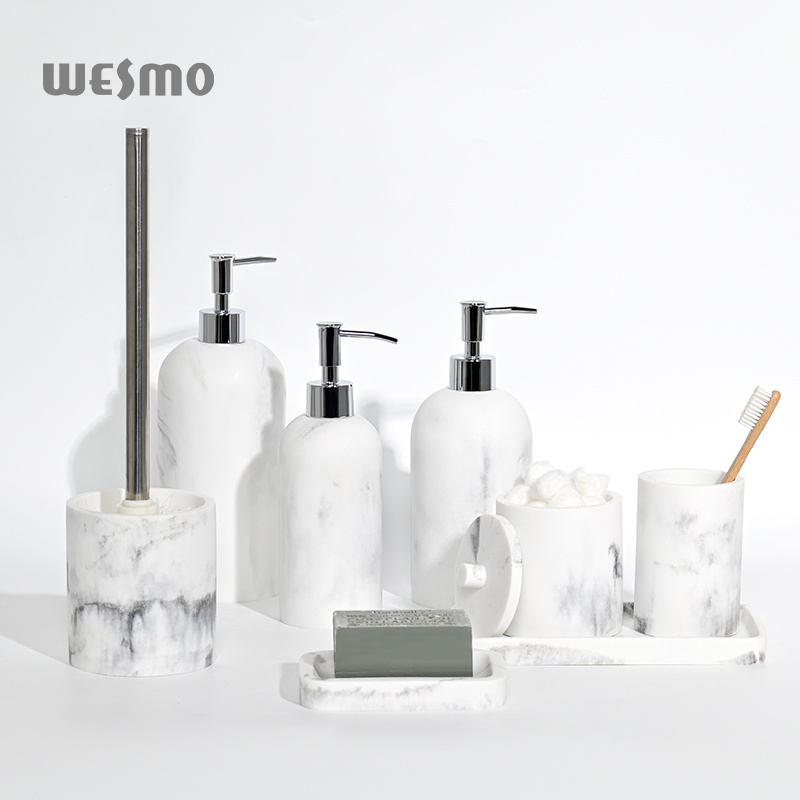
- High and fluctuating raw material costs
- Heavy product weight increasing logistics expenses
- Natural color variation between batches
- Limited scalability for coordinated collections
In many cases, the client's core requirement is the visual and tactile impression of stone, not the stone itself.
Manufacturing Insight: Material Substitution Is a Strategy, Not a Compromise
Through resin-based faux marble techniques, manufacturers can replicate the depth, veining, and surface character of natural stone while gaining:
- Cost stability
- Weight reduction
- Batch-to-batch consistency
- Predictable lead times
When executed correctly, material substitution preserves perceived value while enabling commercial viability—especially for supermarket chains, large-format stores, and multi-channel retail programs.
2. Why Multi-SKU Sets Fail at the Shelf Level
Bathroom accessories are rarely sold as single items.
They are presented as coordinated sets—soap dispensers, trays, tumblers, and canisters displayed together.
A frequent issue arises when:
- Individual items pass inspection
- But the set fails visually due to color mismatch
This typically results from separate molds, different curing cycles, or manual finishing variations across SKUs.
Manufacturing Insight: Color Control Must Be Managed at Set Level
True color consistency cannot be achieved by inspecting items in isolation.
It requires a system-level approach, including:
- Master color references shared across all SKUs
- Synchronized production where possible
- Defined tolerance ranges for acceptable variation
- Final inspection conducted with fully assembled sets
For retail and wholesale buyers, shelf harmony matters more than single-piece perfection.
3. The Paradox of Handcrafted Textures at Scale
Handcrafted textures—organic surfaces, irregular finishes, artisanal details—are increasingly demanded across retail categories.
Yet these same features introduce instability during mass production.
Common failures include:
- Excessive variation between pieces
- Over-correction that removes handcrafted character
- Rejections caused by inconsistent shelf appearance
Manufacturing Insight: Craftsmanship Must Be Controlled, Not Eliminated
Handcrafted does not mean uncontrolled.
Scalable craftsmanship requires:
- Approved texture reference samples
- Defined variation ranges
- Segmented manual processes
- Texture-focused quality inspection
By turning "artistic feel"into measurable production parameters, manufacturers can preserve handcrafted aesthetics while meeting retail consistency standards.

4. A Unified Manufacturing Perspective
Although these challenges appear different—material choice, color consistency, handcrafted texture—they share a common truth:
Manufacturing problems are rarely solved by design alone.
They require:
- Material knowledge
- Process discipline
- Controlled human intervention
- Systematic quality evaluation
At scale, craftsmanship becomes a managed process rather than an abstract concept.
5. Why This Matters to Retail Buyers and Product Teams
For retail brands, supermarket operators, and large-format stores, manufacturing decisions directly affect:
- Shelf presentation
- Return rates
- Reorder confidence
- Long-term supplier reliability
A supplier’s value is not defined by what they can make once—but by what they can make consistently, repeatedly, and predictably.
Conclusion: Manufacturing as Problem Solving
At Wesmo, our role extends beyond producing home decor and bathroom accessories.
We focus on solving real manufacturing challenges that sit at the intersection of design intent and commercial execution.
Material substitution, color system control, and controlled craftsmanship are not isolated techniques—they form part of a broader manufacturing mindset.
For buyers and product teams who understand the complexity behind retail-ready products, this mindset often matters more than surface aesthetics alone.

Feedback

SUPPORT Customization
Copyright © 2024 Wesmo Industries Ltd. All Rights Reserved.


Products
Contact us
Add:Tian-An Hi-Tech Ecological Park No.555, Panyu Avenue North, Guangzhou, China
Emall:wm@wesmoindustries.com
Feedback